
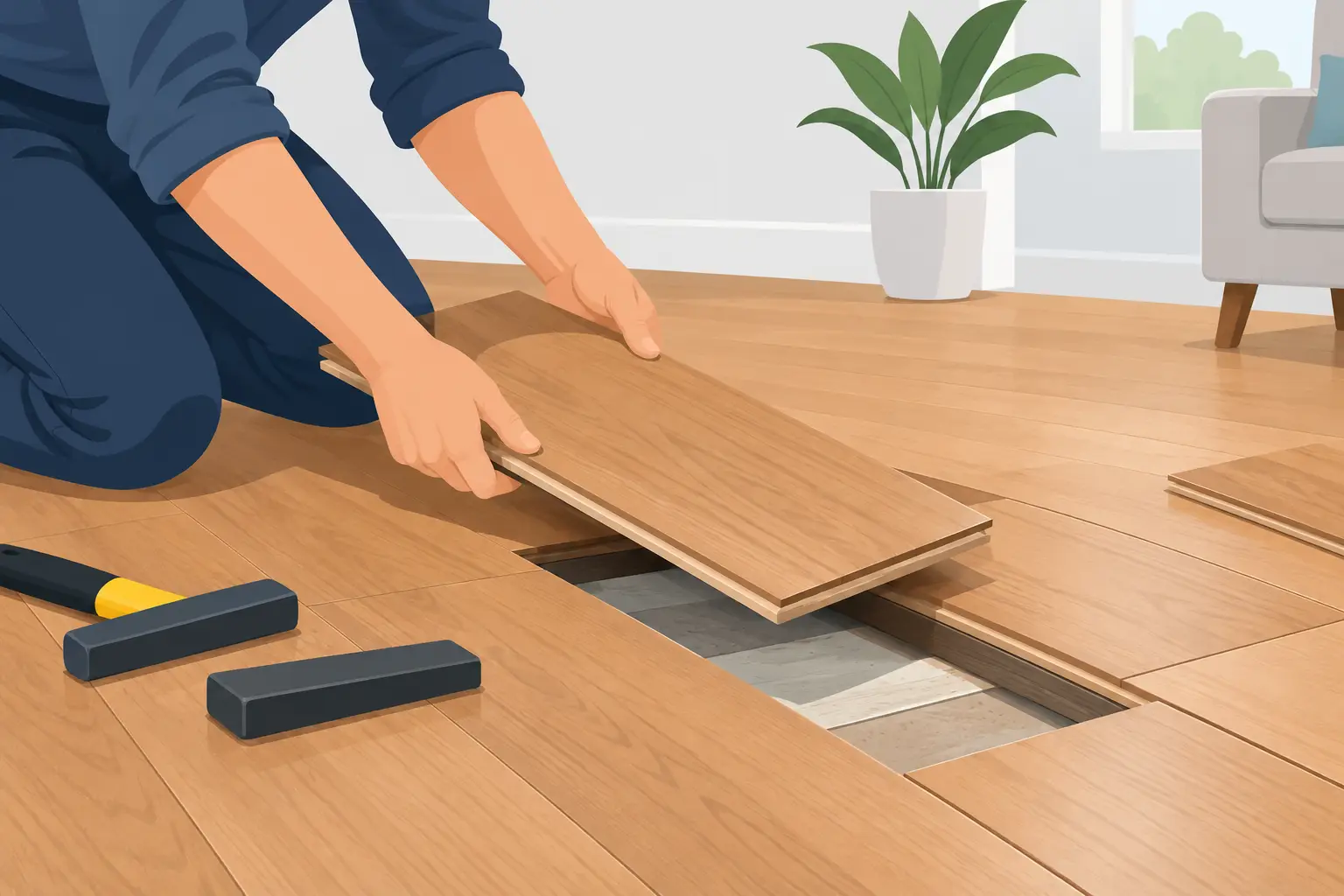
Can floorboards be replaced individually? Yes. National Floors can often remove one or several damaged hardwood boards and install new material without tearing out an otherwise sound floor.
But there is an important distinction homeowners should understand. Replacing individual boards and refinishing individual boards are two very different things.
We can replace a damaged board. If the floor was finished on site, however, trying to sand, stain and finish only that small repaired area rarely produces the professional result we expect. If the goal is to make the repair blend properly, the continuous floor area generally needs to be sanded and refinished together.
When Individual Hardwood Boards Can Be Replaced
Individual board replacement works particularly well when the damage is isolated and the surrounding hardwood remains structurally sound. We commonly encounter repairs involving deep pet stains, water damage from appliances or plumbing, termite damage, burns, broken boards and damage caused during remodeling.
The idea is simple: preserve the good hardwood and replace only what is actually damaged.
Solid hardwood is particularly well suited to this type of repair. The damaged boards can be carefully removed while leaving the surrounding floor in place. Replacement hardwood is then selected to match the existing species, width, thickness and grade as closely as possible.
Depending on the location and extent of the repair, replacement boards can also be laced or woven into the existing flooring rather than creating an obvious straight repair line. This is especially useful when extending hardwood into another area or repairing a larger damaged section.
The carpentry portion of the repair, however, is only the beginning.
Replacing One Board Does Not Mean Refinishing One Board
This is where expectations sometimes become unrealistic.
National Floors receives calls from homeowners asking us to replace and refinish one or two boards while leaving everything around them untouched. It sounds reasonable. If only two boards are damaged, why work on the rest of the floor?
Because a hardwood floor ages as a complete surface.
Sunlight changes the wood. Normal foot traffic changes the finish. Cleaning, oxidation and years of everyday use change its appearance. Even when we know the original stain and finish, the floor surrounding a repair is no longer exactly what it was when those products were first applied.
A freshly sanded piece of hardwood is starting over.
Trying to make that new surface look identical to hardwood that has been aging for years is virtually impossible, particularly on a stained floor.

Think About a New Door on a 10-Year-Old Car
Imagine owning a ten-year-old car that you really like. Unfortunately, someone crashes into one of the doors and the body shop has to replace it.
The replacement door is brand new. The rest of the car has spent ten years exposed to sunlight, weather, washing and normal wear. Even with an excellent paint match, putting a freshly painted door next to the older finish can make the difference noticeable.
A hardwood floor presents a similar problem.
We can replace the damaged wood, but applying fresh stain and finish to a small area places a newly restored surface directly beside an older one. Differences in colour, sheen and normal aging can make the repair stand out instead of disappear.
Stained hardwood makes this even more difficult. Matching a stain sample on new wood is one thing. Matching years of aging, sunlight and wear surrounding that stain is another.
A properly executed hardwood repair should not advertise where the damage used to be.
Why National Floors Does Not Recommend Spot Refinishing
Can someone spot-sand and refinish a repaired hardwood board? Certainly.
Will the finished result meet National Floors' standard? In most cases, no.
Some contractors may disagree, and expectations vary from homeowner to homeowner. Our position comes from what we consider an acceptable professional result.
If a finished-on-site hardwood floor requires board replacement and the customer expects the repair to blend properly, we recommend sanding and refinishing the continuous floor area rather than attempting to disguise a small refinished patch.
We would rather explain that before beginning the project than complete a less expensive repair that we would not be satisfied with ourselves.
This is also why hardwood repairs and professional sanding and finishing frequently go together. Replacing the damaged wood restores the floor physically. Sanding and refinishing the surrounding floor is what gives the repair its best opportunity to disappear visually.
Matching the Existing Hardwood Still Matters
Sanding the complete area does not eliminate the need for careful material selection.
The replacement wood should match the existing floor as closely as possible in species, width, thickness and grade. Grain and natural colour variation matter as well.
Older hardwood floors can create additional challenges because some dimensions and products are no longer commonly stocked. A flooring specialist may need to locate suitable material or modify replacement boards to work with an existing floor.
There is also a difference between simply filling a hole and creating a repair that belongs in the original floor. Properly lacing new boards into existing hardwood can help break up the repair and avoid an unnatural line where old flooring meets new.
Once everything is installed correctly, sanding the floor together creates a uniform surface before stain and finish are applied.
Even a Small Hardwood Repair Can Take Several Days
Another common misunderstanding involves price.
A homeowner may look at two damaged boards and reasonably assume that replacing them should cost only a few hundred dollars. The physical repair may indeed be small. The process required to complete it professionally is not necessarily small.
Replacing the boards can involve removal, fitting, fastening or adhesive work, sanding and preparation. If the floor is stained, the staining process must also be completed. Then the appropriate sealer and finish coats need to be applied with proper drying time between coats.
Even a relatively small project can therefore require work spread across several days.
Flooring contractors also have minimum charges. The crew, equipment, transportation and scheduling requirements do not disappear because only a few square feet of flooring are damaged.
A small repair does not automatically mean a small job.
We understand that this can be disappointing for a homeowner working with a very limited repair budget. But eliminating necessary steps simply to reach a lower price is not how National Floors approaches hardwood restoration.
We would rather tell you what the job realistically requires before work begins.
The Cause of the Damage Comes First
Before replacing anything, we also want to know why the original boards failed.
If a dishwasher leaked, the appliance or plumbing problem needs to be corrected. If moisture is coming through a concrete slab or subfloor, installing new hardwood before correcting the moisture condition can simply damage the replacement material.
Termite damage should be treated before new flooring is installed. Pet urine may have affected more than the visible surface. Remodeling damage may require subfloor repairs before replacement boards can be properly secured.
Installing beautiful new hardwood over an unresolved problem doesn't repair the floor. It only hides the problem temporarily.
What About Engineered Hardwood?
Individual engineered hardwood boards can sometimes be replaced as well, although the installation method changes the repair.
Engineered flooring may be nailed, glued directly to concrete or installed as a floating system. A replacement technique that works for a traditional nail-down solid hardwood floor may not be appropriate for a glue-down engineered floor.
There is also the wear layer to consider. Some engineered hardwood has enough real wood on the surface to permit sanding, while other products have a thin veneer that severely limits or eliminates that option.
This needs to be determined before anyone puts a sanding machine on the floor.
When Individual Board Replacement Is Not Enough
Selective repair makes the most sense when the problem is truly selective.
If a large portion of the floor is cupped, crowned, loose, termite damaged or affected by moisture, replacing a handful of boards may only treat the most visible symptoms.
Surface scratches, worn finish and faded colour are different. Those conditions often don't require board replacement at all. If the wood itself remains sound, sanding and refinishing the hardwood floor may be all that is necessary.
The first job of a flooring contractor should therefore be determining what actually needs replacing rather than automatically removing good hardwood.
Repair the Damage Without Making the Repair the First Thing You See
One damaged floorboard does not mean you need a new floor.
National Floors can often replace individual boards, repair isolated sections and preserve the hardwood surrounding them. But we also believe homeowners deserve realistic expectations about what happens afterward.
If your hardwood floor was finished on site and you expect a professional-looking repair, replacing the damaged boards may be only the first step. The continuous floor generally needs to be sanded and refinished together so the repaired area blends properly.
That approach costs more than touching up a couple of boards, and even a small repair can require several days when multiple finish coats are involved. We understand that isn't the answer every homeowner wants to hear.
But we'd rather give you the correct answer before taking the job than promise an inexpensive shortcut that won't meet our standards when we're finished.
If you have isolated hardwood damage, National Floors can determine whether the boards can be repaired or replaced, identify what caused the damage and explain what will be necessary to make the finished floor look right.
