
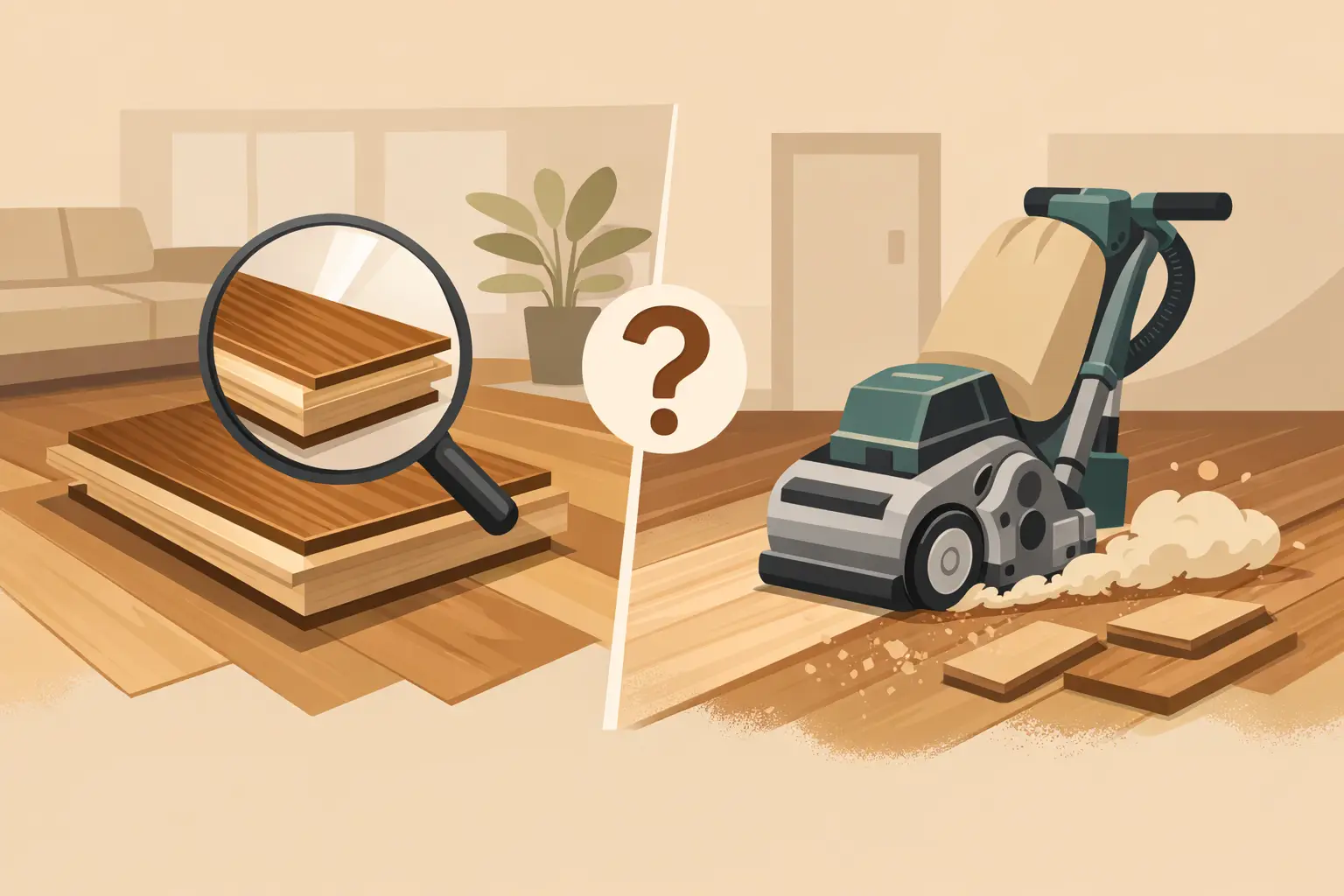
Do engineered floors need sanding in the same way as traditional solid hardwood? Usually not. Sanding should not be considered routine maintenance for engineered flooring. It is a restoration process that should only be considered after determining how much genuine hardwood is available on the surface.
That distinction is extremely important. Properly refinishing a suitable engineered floor can extend its useful life considerably. Sand through a thin hardwood wear layer, however, and the underlying core can be exposed. Once that happens, conventional refinishing cannot restore the damaged board.
How Is Engineered Hardwood Different From Solid Hardwood?
Solid hardwood is manufactured from a single piece of wood. Engineered hardwood has a layer of genuine hardwood bonded to multiple layers underneath.
That layered construction gives engineered hardwood greater dimensional stability and makes it useful in installations where traditional solid hardwood may not be the best choice.
The tradeoff is the amount of hardwood available for future sanding.
With solid hardwood, there is substantial usable wood above the tongue-and-groove construction. With engineered hardwood, only the upper wear layer can be safely sanded. Once that hardwood layer is gone, the material underneath is not a surface that can be conventionally refinished.
Does an Engineered Hardwood Floor Need Sanding or Just a New Finish?
Many engineered hardwood floors never need sanding simply because the protective finish is still doing its job.
Light scratches, normal dulling and minor wear do not necessarily mean the hardwood underneath has been damaged. If the wear is limited to the coating, a professional maintenance coat may be a better option than complete sanding.
A recoat prepares the existing finish so another compatible protective coat can be applied. The objective is to renew the coating without sanding the hardwood back to bare wood.
This distinction is particularly valuable with engineered hardwood because every unnecessary sanding reduces a limited amount of usable wood.
Regular hardwood floor cleaning, furniture protection and prompt attention to spills can also help preserve the existing finish and delay the need for more extensive restoration.
The Wear Layer Determines Whether Complete Sanding Is Possible
The upper layer of genuine hardwood on an engineered floor is commonly called the wear layer. Its thickness varies considerably between flooring products.
Some engineered hardwood has a substantial wear layer. Other products have only a very thin layer of genuine wood on the surface.
Before National Floors considers completely sanding an engineered floor, we need to determine how much usable hardwood is actually available. As a general rule, we want approximately 3 mm or more of usable hardwood before considering a complete sanding and refinishing process.
That measurement is not an automatic guarantee that the floor can or should be sanded. Previous refinishing, board condition, damage, flooring construction and installation all need to be evaluated as well.
The objective is to determine whether enough hardwood remains to perform the necessary sanding safely while avoiding the core underneath.
A Thin Wear Layer Does Not Automatically Prevent a Recoat
Wear-layer thickness is primarily a concern when the hardwood itself needs to be sanded.
A maintenance coat is different because the objective is not to remove the hardwood surface. Instead, the existing finish is properly prepared so another compatible finish coat can bond to it.
That means an engineered floor that does not have enough hardwood for complete sanding may still be a candidate for a recoat if the existing coating is intact and compatible.
A recoat cannot correct deep scratches, damaged stain, bare wood, severe discoloration or physical damage to the boards. It renews the protective finish; it does not renew the hardwood underneath.
Previous Sanding Changes How Much Hardwood Remains
An engineered floor may have originally been manufactured with a substantial wear layer and still be a poor candidate for another sanding.
Every complete refinishing removes some hardwood. If the floor has previously been sanded, we need to consider how much material was removed and how much remains today.
Previous workmanship also matters. An overly aggressive sanding may leave certain areas considerably thinner than others.
Edges, transitions and areas where sanding equipment changed direction can sometimes contain less material than the rest of the floor.
This is why the current condition of the flooring matters more than simply knowing the original manufacturer's wear-layer specification.
How Do We Determine the Thickness of an Engineered Floor?
When possible, the flooring profile can be examined at an accessible edge, floor vent, transition or another location where the construction of the board is visible.
Original manufacturer information can also be useful when it is available.
What we do not want to do is guess based solely on the appearance of the floor. From above, an engineered oak floor can look nearly identical to solid oak.
The fact that the surface is genuine hardwood tells us what the floor is made from. It does not tell us how much hardwood is available underneath the finish.
When Complete Sanding May Be Appropriate
If an engineered floor has sufficient usable hardwood, complete sanding may be considered when the damage extends beyond the protective finish.
Deep scratches, worn areas exposing bare wood, damaged stain and widespread surface deterioration may require removal of the existing coating and a controlled amount of hardwood underneath.
Sanding also provides an opportunity to change the color of a suitable engineered hardwood floor. Once the old finish and stain have been removed, a new stain can be applied before the protective finish system.
The amount of material removed should always be limited to what is necessary. With engineered hardwood, preserving the remaining wear layer is particularly important because that material cannot be replaced once it has been sanded away.
Moisture Damage Must Be Addressed Before Sanding
A sufficient wear layer does not make a moisture-damaged engineered floor ready for sanding.
Engineered hardwood is more dimensionally stable than traditional solid hardwood, but it is not waterproof.
Moisture can affect the hardwood surface, the layered construction underneath, the adhesive and the subfloor.
This is especially important with engineered flooring installed over concrete. Moisture moving through a slab can affect both the flooring and the adhesive holding a glue-down installation in place.
Boards that are cupped, swollen, loose or lifting need to be evaluated before sanding. The source of the moisture should be identified and corrected, and the flooring should be allowed to stabilize before deciding what can be restored.
Delaminated Engineered Flooring Cannot Be Fixed by Sanding
One problem unique to layered flooring is delamination.
Engineered hardwood depends on the bond between its layers. If those layers begin separating because of moisture, manufacturing failure or another condition, sanding the surface does not restore that bond.
Individual damaged boards may sometimes be replaced while the surrounding flooring remains in place. More extensive delamination can make replacement a more practical solution.
This is another reason the entire condition of the flooring needs to be evaluated rather than looking only at scratches or finish wear.
Deep Stains May Have Limits
Water stains, pet stains and other discoloration can sometimes be improved during sanding, but engineered hardwood places an important limit on how far we can pursue a stain.
If discoloration extends deeply into the hardwood, aggressively sanding until every trace disappears may remove too much of the wear layer.
Preserving the integrity of the floor is more important than removing excessive amounts of hardwood in pursuit of a perfect cosmetic result.
Depending on the location and severity of the damage, replacing an individual board or accepting some remaining natural variation may be preferable to excessive sanding.
Engineered Hardwood Requires Conservative Sanding
When an engineered floor is suitable for complete refinishing, the sanding process needs to be controlled carefully.
The objective is to remove the existing finish and necessary surface damage while preserving as much of the hardwood wear layer as possible.
Edges and other detailed areas require particular care because aggressive sanding can remove material very quickly.
The floor is progressively prepared with the appropriate abrasive sequence until the hardwood is ready for staining, if desired, and the new protective finish.
Professional dust-control equipment captures the majority of sanding dust during this process, making modern hardwood refinishing considerably cleaner than older sanding methods.
Signs an Engineered Floor Should Be Evaluated
An inspection may be worthwhile when an engineered hardwood floor develops widespread worn traffic areas, deep scratches, exposed wood, damaged finish or significant discoloration.
Peeling or failing coatings should also be evaluated because simply applying another finish over a poorly bonded coating may not correct the problem.
Movement is a different warning sign. Cupping, lifting, loose boards or separation can indicate moisture or installation problems that should be addressed before cosmetic restoration is considered.
Having the floor evaluated before the hardwood surface becomes severely damaged can preserve more restoration options.
Have the Engineered Floor Evaluated Before Sanding
Engineered hardwood should not automatically be replaced when it becomes worn, but it should not automatically be sanded either.
The correct solution may be routine maintenance, a professional recoat, targeted board repairs, complete sanding and refinishing or replacement where the flooring has reached its limit.
A qualified hardwood flooring contractor should identify the flooring construction, evaluate the remaining wear layer and determine whether moisture or physical damage needs to be addressed before recommending complete sanding.
National Floors is a California C-15 licensed hardwood flooring contractor, license #903508, serving homeowners throughout the San Francisco Bay Area. We work with both solid and engineered hardwood floors and evaluate whether existing flooring can be safely restored before recommending replacement.
If an engineered hardwood floor still has sufficient usable wood beneath its worn surface, careful restoration may give it many more years of useful life.
