
At some point, you have to go old school. Get in the car, visit a flooring store and actually see what is available.
Once you walk through the door, the first thing you may notice is the sheer number of choices. There are hardwood displays, sample boards, kiosks, different species, colors, widths, grades and finishes.
Then you see the price of the flooring and start doing the math.
That is where things can go south.
The Price of the Flooring Is Not the Price of the Floor
The material price is only one part of a hardwood flooring project. To determine what a new floor will actually cost, several other expenses need to be considered.
First, the existing flooring normally has to come out. That could mean carpet, linoleum, laminate, tile or another flooring material. For a premium hardwood installation, the condition and flatness of the surface underneath matter. Leaving unsuitable material behind can affect how flat the new hardwood lies and may contribute to movement or noise after installation.
Then there is another possibility.
You Pull Up the Carpet and Find Hardwood
Every once in a while, carpet is removed and the homeowner discovers original hardwood underneath.
You just struck gold.
Many older Bay Area homes were originally built with hardwood flooring. What looks like an old, tired floor underneath that carpet may actually be high-quality unfinished oak that would be extremely expensive to replace today.
Before tearing it out, stop and rethink the project.
A comparable new premium oak floor can easily represent a substantial investment once material and installation are included. If the existing hardwood has enough usable wood remaining and is structurally sound, it may be possible to sand and finish it with a custom stain for a fraction of the cost of replacing it.
That also gives you something many new flooring products cannot duplicate: an original hardwood floor finished specifically for your home.
Learn more about hardwood floor refinishing and restoration before deciding that an older hardwood floor needs to be replaced.

Now Add the Costs You Didn't See on the Display
Let's get back to shopping for a new floor.
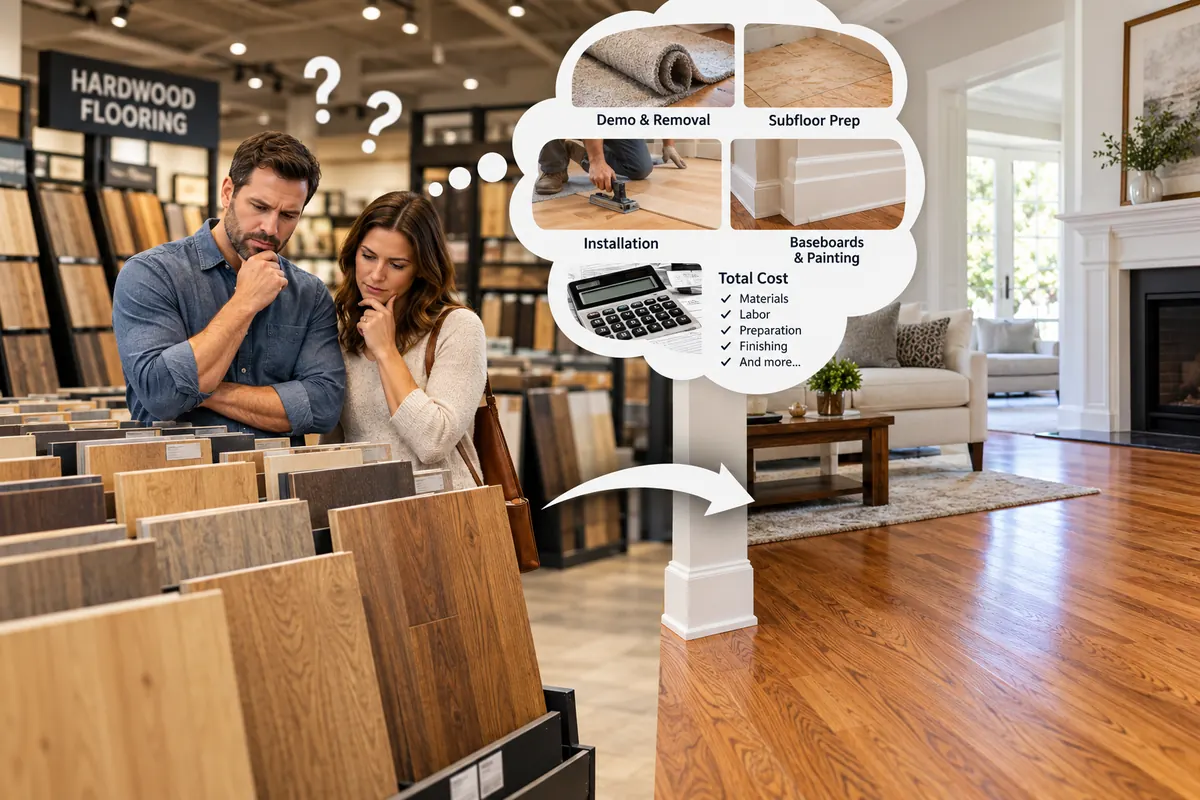
The old flooring may need to be demolished and removed. The subfloor may need preparation or repair. Then you have the installation cost, which can vary depending on the contractor and installation method.
A wooden subfloor will often allow for a nail-down hardwood installation, which is generally one of the more economical installation methods.
A concrete slab changes the equation.
The hardwood may need to be glued directly to the slab, adding the cost of adhesive and additional labor. Another installation method may involve installing plywood over the slab first, which adds plywood, adhesive, fasteners and labor before the hardwood itself is installed.
Then there are the baseboards.
There are dozens of profiles, sizes and styles available at different price points. The old baseboards may need to be removed, new material purchased and installed, and then painted.
Suddenly, that price you saw on the flooring display doesn't tell you very much about what the completed project is actually going to cost.
How to Choose the Hardwood Floor
Before worrying about who is going to sell you the flooring, determine what you actually want.
- Choose the wood species.
- Choose the grade.
- Determine whether solid or engineered hardwood is appropriate for the installation.
- Choose the width and dimensions of the floorboards.
Any competent flooring store should be able to help you work through those initial decisions.
But what happens next is where homeowners have another option.
Prefinished vs. Finished on Site
When working directly with National Floors, one of the major decisions is whether you want a prefinished floor or a floor that is finished on site.
Prefinished hardwood arrives with the finish already applied. After the flooring has properly acclimated to the home, it can be installed and, depending on the installation method, usually put into service relatively quickly.
There are advantages to that convenience, but premium prefinished hardwood isn't cheap. Run your hand across many prefinished floors and you will also feel the individual boards and micro-beveled edges. The floor may look flat from across the room, but the surface isn't the same as a hardwood floor that has been sanded flat after installation.
Finished-on-site hardwood is where things can become surprisingly attractive for the homeowner.
Let's say you decide that you want oak.
Tell your National Floors representative the species you want. We can explain the differences between the available grades, discuss board dimensions and installation requirements, and price the appropriate unfinished flooring.
Unfinished oak can often be purchased for considerably less than a comparable premium prefinished product. Part of that material savings can then be applied toward sanding, staining and finishing the floor after installation.
Once the complete project is quoted, homeowners may discover that the difference between the two options is much smaller than they expected.
But the finished product is very different.
A properly installed, sanded and finished hardwood floor has a smooth, continuous appearance. The floor can be custom stained to complement the home, and the sheen can be selected as part of the finishing process.
The look and feel of a quality finished-on-site hardwood floor is difficult to beat.
So Why Start at a Flooring Store?
Remember the car-shopping analogy?
Use the flooring store to educate yourself if you need to. Look at different woods. Compare widths. See the colors in person. Learn the difference between engineered and solid flooring. Decide what you like.
Once you know what you want, it's time to shop for the company that will actually turn those materials into a finished floor.
Contact a licensed hardwood flooring contractor such as National Floors and tell us exactly what you are considering. Let us inspect the home, determine the proper installation method and provide a quote for the complete project.
Then get another quote.
Compare the materials, preparation, installation method, finishing process and total price—not simply the cost per square foot printed on a flooring sample.
You're Also Paying for the Flooring Store
There is another cost that isn't printed on the flooring sample: the flooring store itself.
A retail flooring showroom costs money to operate. There is rent or a mortgage on the commercial space, utilities, insurance, employees, sales commissions, advertising, flooring displays, samples, inventory, office expenses and all the other costs associated with maintaining a storefront.
Those expenses have to be paid.
Ultimately, the money comes from the customers buying the flooring and installation services.
There is nothing unusual about that. Every retail business has overhead and needs to make a profit. But as the customer, you should ask a very simple question:
Do I need to pay for the overhead of a retail flooring store to get the hardwood floor I want?
When you first begin shopping, the showroom may be useful. You can see different species, grades, widths and colors in person. But once you know exactly what you want, the value of that showroom can become much smaller.
At that point, you don't need hundreds of displays. You need the right material and someone who knows how to install and finish it properly.
Cut Out the Middleman
There can be another layer of cost as well.
Many flooring retailers sell the material and then subcontract the installation. The homeowner deals with the flooring store, while another company or installation crew performs the actual work.
Now you potentially have multiple businesses that need to make money from the same project.
The homeowner may be paying for the flooring material, the retailer's overhead and profit, and the installation—all while dealing indirectly with the people responsible for actually building the floor.
For some homeowners, the convenience of a large retail showroom may be worth that additional layer. There is nothing wrong with choosing that route.
But if your goal is to put as much of your budget as possible into the actual hardwood floor, it makes sense to compare that approach with hiring the flooring contractor directly.
Go Directly to the Flooring Contractor
National Floors takes a different approach. We are a licensed C-15 flooring contractor.
Instead of starting with a retailer and eventually working your way to the people responsible for the floor, you can start with the flooring contractor.
Tell us what you want. We can help you select the right hardwood, determine the appropriate installation method, install the floor, and sand and finish it when a finished-on-site floor is selected.
You don't need to pay for a showroom containing hundreds of flooring choices once you've already decided what you want.
You need the right floor, the right installation method and a contractor capable of delivering the finished result.
Do your shopping. Learn what you like. Decide what you want. Then talk directly to the people who know how to build the floor.
And don't take our word for it. Get another quote and compare.
Compare the species and grade of hardwood, preparation, installation method, finishing system and total project price. When everything is placed side by side, you can see where your money is going—and what you're actually getting for it.
