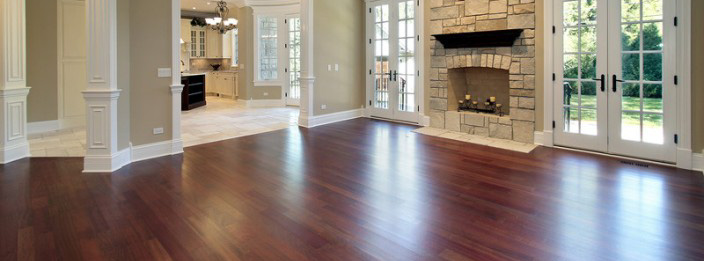

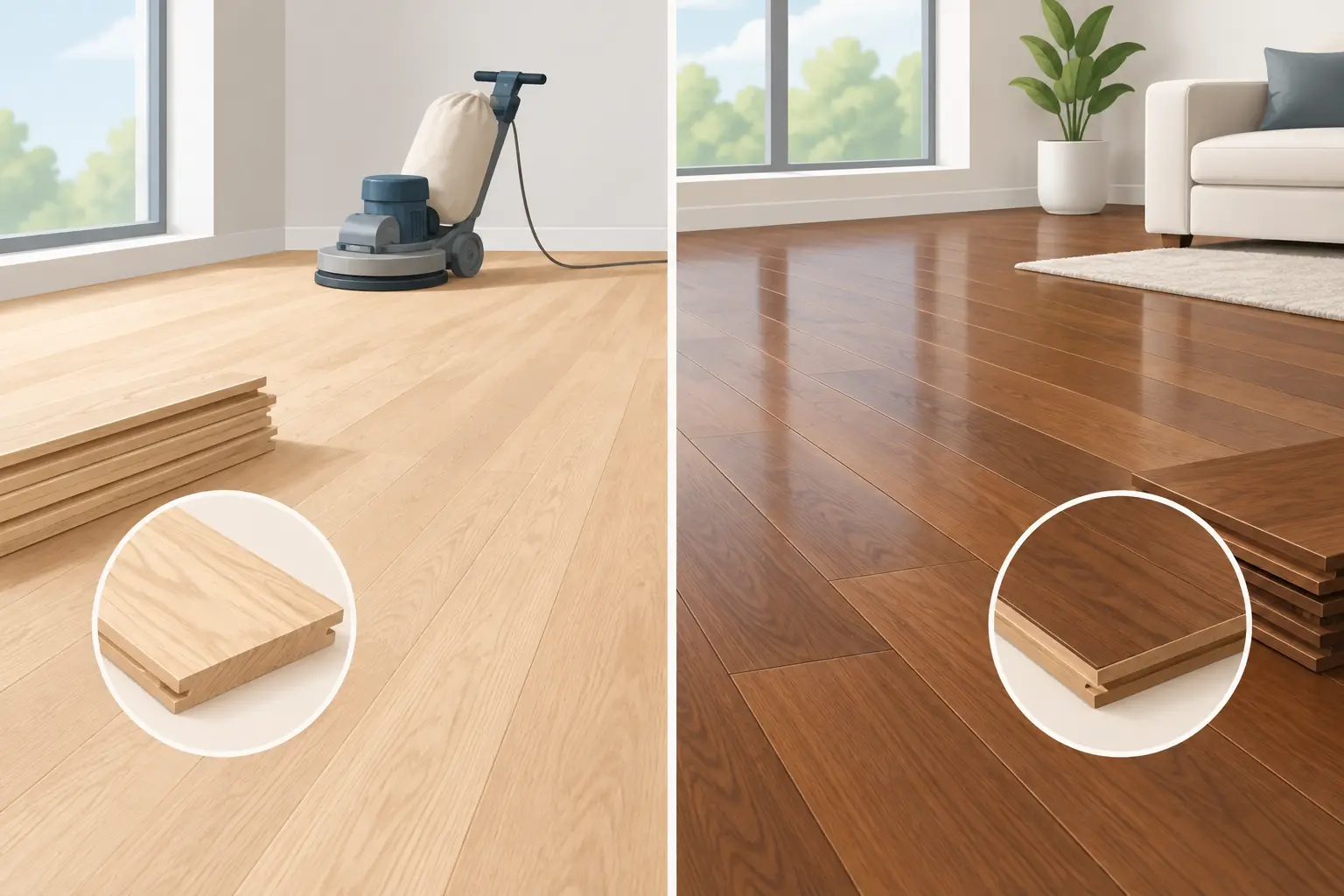
Prefinished flooring arrives from the manufacturer already stained and coated. Once it has been properly acclimated and installed, much of the work is complete.
A floor that will be finished on site arrives as unfinished hardwood. It goes through the same acclimation and installation process, but that's only the beginning. After installation, the entire floor is sanded flat, cracks and imperfections are filled, the floor is sanded again, and then it can be custom stained and finished.
The extra work takes time, but the finished appearance can be extraordinary.
What Is a Finished-on-Site Hardwood Floor?
A finished-on-site hardwood floor is installed as unfinished wood.
Before installation, the flooring needs to acclimate to the conditions of the home. Once properly acclimated, the boards are installed using the appropriate method for the flooring and subfloor.
Then the finishing process begins.
The entire installed floor is professionally sanded. This removes minor height differences between individual boards and creates a flat, uniform surface.
After the initial sanding, cracks and small imperfections between boards can be filled with hardwood floor filler. The floor is then sanded again through the appropriate sequence until it is ready for stain and finish.
The homeowner can choose the stain color, finish system and sheen.
The result is not simply installed hardwood. It is a floor that has been built, flattened and finished as one continuous surface.
What Is Prefinished Hardwood Flooring?
Prefinished hardwood takes a different approach.
Each board is stained and coated at the factory before it arrives at the home. The flooring still needs the proper acclimation and installation procedures, but there is no need to sand and finish the entire floor afterward.
This gives prefinished hardwood its biggest advantage:
Time.
If a prefinished floor is nailed down, once the material has properly acclimated and the installation is complete, the floor can generally be walked on immediately. There is no sanding, staining or finish-curing schedule afterward.
A glue-down prefinished installation is different. The flooring may be finished, but the adhesive still needs adequate curing time before the floor is subjected to normal traffic. The manufacturer's requirements for the adhesive system need to be followed.
Prefinished flooring can therefore shorten a project considerably, particularly with a nail-down installation.
There is a trade-off. Prefinished flooring generally costs more for the material itself, and the finished appearance is different from a floor that has been sanded and finished after installation.
The Biggest Visual Difference Is Under Your Feet
Look closely at a prefinished hardwood floor and you'll normally see the outline of every individual board.
That's because prefinished flooring commonly has a bevel or micro-bevel around its edges. Each plank was finished separately at the factory and then assembled into a floor inside the home.
There can also be slight height differences from one board to another. These variations may be small, but the floor was never sanded as one complete surface after installation.
A finished-on-site floor eliminates those differences.
Once all of the unfinished boards have been installed, the sanding process brings the entire floor into the same plane. Micro-bevels aren't necessary. Minor unevenness between boards is removed. Cracks are filled and the flooring is progressively sanded until the surface is smooth and uniform.
Instead of seeing and feeling a collection of individually finished boards, you see one continuous hardwood floor.
For a premium hardwood appearance, there really is no comparison.
Finished on Site Gives You Custom Color
With prefinished flooring, you choose a color from the manufacturer's available product line.
With a floor finished on site, the hardwood itself becomes our canvas.
Stain samples can be applied directly to the actual flooring so the homeowner can see how the selected wood species responds to different colors.
This is important because hardwood is a natural product. Red oak and white oak don't react identically to the same stain. Even boards of the same species have natural variations in grain and color.
Stains can also be mixed when necessary to create a custom color or help coordinate a new floor with existing hardwood, cabinetry, stairs or other features of the home.
The homeowner isn't limited to picking a factory color from a display rack.
You Can Also Choose the Finish
Color isn't the only choice.
A floor finished on site allows the homeowner and flooring contractor to select the finish system appropriate for the project.
There are residential finishes as well as extremely durable commercial-grade finish systems. The right choice depends on the floor, expected traffic and how the space will be used.
A home doesn't necessarily have the same requirements as a busy commercial property, gym or other high-traffic environment.
This is one of the advantages of finishing after installation: the finish can be selected for the floor rather than accepting whatever coating came from the flooring manufacturer.
Finished on Site Gives You a Choice of Sheen
Sheen has a surprisingly large effect on how a hardwood floor looks.
Prefinished flooring is commonly offered in lower sheens, generally ranging from matte to satin.
There is a practical reason for this.
The lower the sheen, the less readily small scratches, surface imperfections and normal wear are reflected by light. A higher-gloss surface acts almost like a mirror. Light traveling across the floor can reveal scratches, dents and other imperfections much more readily.
Lower sheens therefore help manufacturers provide a floor that maintains a more consistent appearance during everyday use.
With a floor finished on site, the homeowner has much greater freedom.
Depending on the finish system, you can select matte, satin, semi-gloss or higher-gloss appearances. The choice can be based on the look of the room rather than being limited to the sheen supplied by the flooring manufacturer.
Why Premium Floors Are Commonly Finished on Site
There is a reason custom homes, commercial spaces, gyms, museums and other projects where appearance matters often go through the additional process of installing unfinished hardwood, sanding it and finishing it afterward.
The objective isn't simply to cover the floor with wood.
The objective is to create a finished hardwood surface.
Sanding after installation allows the flooring contractor to remove the minor irregularities inherent in assembling hundreds or thousands of individual pieces of hardwood.
Filling helps address small cracks and imperfections. Progressive sanding prepares the entire floor uniformly. Staining establishes the desired color, and the selected finish creates the final appearance and protection.
It requires more work because the finished result is different.
Prefinished Flooring Still Has an Important Place
None of this means prefinished hardwood is a bad product.
Its greatest strength is convenience.
Consider a homeowner who can't have part of the house unavailable while a floor is sanded, stained and finished. Or a project with a very tight completion schedule.
A nail-down prefinished floor can be an excellent solution. Once properly acclimated and installed, there is no additional sanding and finishing process keeping the room out of service.
Factory-applied finishes can also be extremely durable.
You're essentially exchanging some of the customization and premium appearance of a floor finished on site for a much faster installation process.
Finished on Site Takes Longer
This is the trade-off homeowners need to understand before making the decision.
Both flooring types need appropriate preparation, acclimation and installation.
Prefinished flooring is essentially approaching the finish line once installation is completed.
With unfinished hardwood, we're just entering the next stage.
The floor must be sanded, filled and sanded again. If stain is desired, the color needs to be selected and applied. Then the chosen finish system is applied according to its required schedule.
The floor also needs appropriate drying and curing time before returning to normal use.
Our hardwood floor sanding and finishing service is where an installed unfinished floor is transformed into the completed surface the homeowner will live with for years.
It takes longer because considerably more is being done to the floor.
What Happens When a Floor Eventually Needs Repair?
There is another advantage to thinking beyond installation day.
A hardwood floor may eventually be scratched, damaged by water or need individual boards replaced.
With a floor that was finished on site, repairs can often be incorporated into the existing hardwood and the affected area sanded and blended.
Prefinished flooring can be repaired as well, but matching the original factory product years later can present a challenge. Product lines disappear, colors change and the existing hardwood naturally ages from exposure to light.
If you install prefinished hardwood, keeping several extra boards from the original installation is a very good idea.
Finished on Site Versus Prefinished: Which Makes Sense?
If your primary concern is speed, prefinished hardwood has a clear advantage.
For a nail-down installation, the floor can generally be used as soon as the installation is completed. A glue-down installation will still require the appropriate adhesive curing period.
If your priority is the finished appearance, customization and having the hardwood sanded completely flat after installation, finishing on site offers something prefinished flooring cannot duplicate.
You gain control over:
- Stain color
- Custom stain mixtures
- Finish system
- Commercial-grade or residential finish options
- Sheen
- Surface flatness
- Filling of small cracks and imperfections
- Matching and blending with existing hardwood
It takes additional time and labor, but those extra steps are precisely what create the finished result.
There Is a Difference Between Installing a Floor and Finishing One
At National Floors, we've spent decades working with hardwood flooring from installation through sanding, staining, repair and refinishing.
Prefinished flooring provides a legitimate shortcut when time is the priority. Once a nail-down floor is installed, the homeowner can begin using it without waiting for an on-site finishing process.
But when a customer wants a premium hardwood floor, our preference is easy to understand.
Install the hardwood. Sand it flat. Fill the imperfections. Sand it again. Choose the color. Choose the finish. Choose the sheen.
When a hardwood floor is finished on site by an experienced professional, the result can be nothing short of extraordinary.
