
For Bay Area homeowners, moisture can come from an obvious plumbing leak, but it can also come from a damp crawlspace, a concrete slab, a dishwasher or refrigerator connection, wet mopping, poor ventilation, exterior water intrusion or a seasonal shift in indoor humidity. The right repair depends on the source, how long the floor has been exposed to moisture and whether the wood has stabilized.
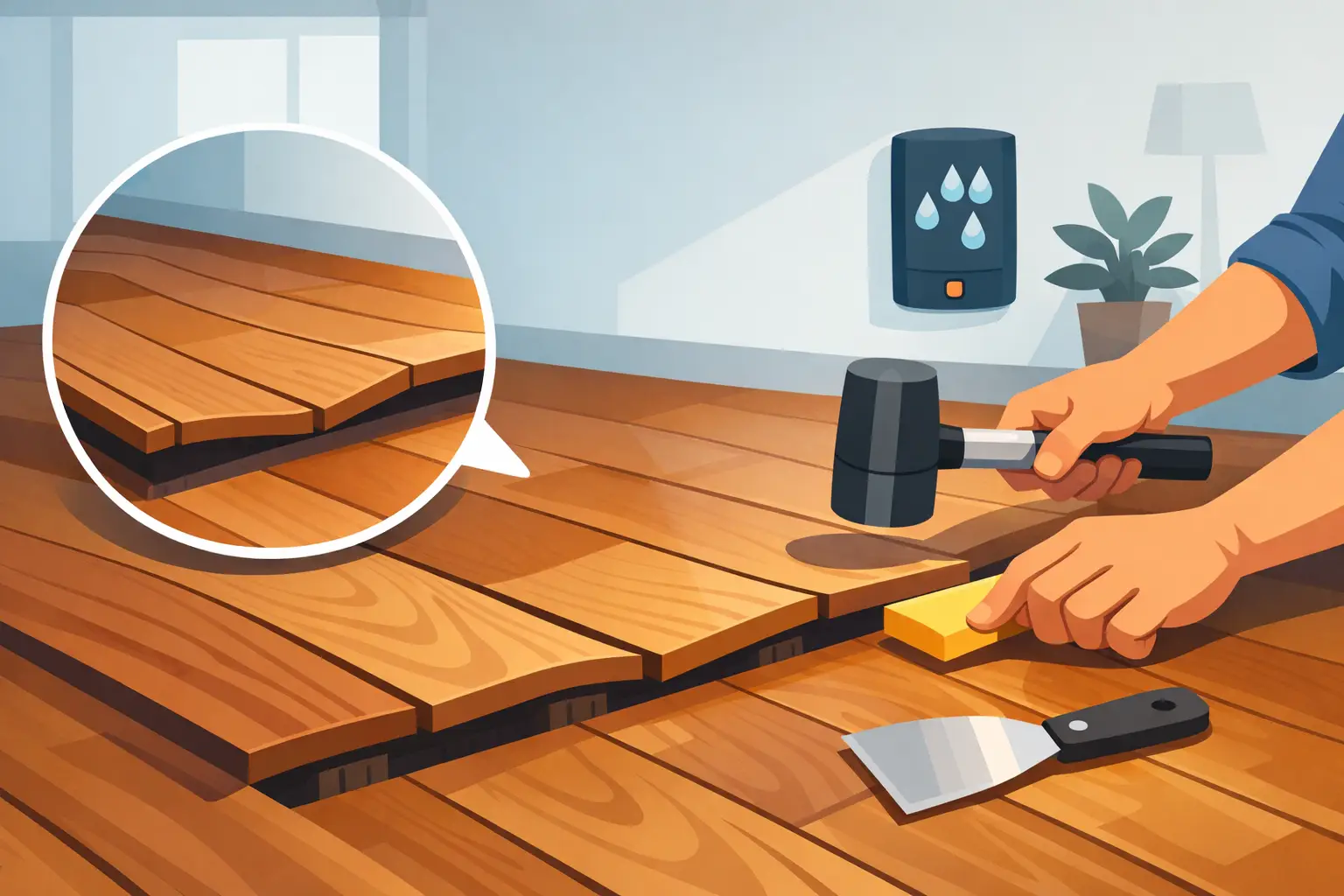
Why Hardwood Floors Cup
Wood absorbs and releases moisture. When the underside of a board takes on more moisture than the finished face, it expands. Because the top surface remains comparatively dry, the board bends upward at both edges and creates the familiar concave profile known as cupping.
This is common in solid hardwood, especially where a subfloor or crawlspace has elevated moisture levels. It can also affect engineered flooring, although its layered construction may respond differently. Engineered boards can cup from severe moisture exposure, but the amount of real wood in the wear layer determines whether corrective sanding is even an option once the floor is dry.
The location and pattern of the damage can offer useful clues. Cupping across an entire room often points to moisture below the floor, high indoor humidity or inadequate moisture protection. Cupping concentrated near a sink, dishwasher, refrigerator, exterior door or plumbing fixture more often suggests a localized spill, leak or water intrusion. If several boards are dark, stained, soft or separating, the damage may have progressed beyond simple drying.
How to Fix Cupped Hardwood Floors Without Causing More Damage
The first task is to stop the moisture source. Repair leaks, address drainage outside the property, check appliance connections and make sure water is not entering through a door threshold, window or exterior wall. If the floor is over a crawlspace, inspect for damp soil, standing water, condensation and other sources of excess moisture. For floors installed over concrete, moisture testing is especially important before repair or refinishing work begins.
Next, remove any surface water and allow the moisture level to come down gradually. Fans, dehumidification and the home's normal heating or cooling system can improve air circulation and help the drying process. Avoid applying intense heat directly to the flooring. Fast, uneven drying can cause additional movement, checking or cracking. Rugs and other coverings should also be removed from the affected area so they do not trap moisture against the floor.
There is no universal drying time. A minor spill addressed quickly may settle within days, while a significant leak or saturated subfloor can require weeks or longer. Moisture meters can be used to compare the flooring, subfloor and unaffected areas of the home. These measurements matter because a floor can look and feel dry before its moisture content has actually stabilized.
Resist the temptation to sand the floor as soon as the boards begin to flatten. Cupped boards can move back toward their original shape as they dry. If the raised edges are sanded flat while the boards still contain excess moisture, the boards may continue changing shape as they dry and eventually become higher in the center than at the edges. This condition is known as crowning.
Crowning can require the floor to be sanded again, unnecessarily removing additional wood and reducing the number of times the floor can potentially be refinished during its lifetime.
When the Floor May Recover on Its Own
If the cupping is slight, the finish remains intact and the moisture exposure was brief, patience may be the best initial repair. Once the moisture source has been eliminated, maintain reasonably stable conditions in the home and monitor the flooring over time. Solid hardwood can sometimes recover remarkably well when the source of the moisture is corrected before the boards become permanently distorted.
Do not judge recovery only by how the floor feels underfoot. Watch for continuing movement, open joints, lifted boards, finish damage or changes in the shape of the flooring. A floor that is still changing is not ready for sanding, staining or recoating.
When Sanding and Refinishing Are the Right Repair
Once moisture readings have stabilized and the floor has had sufficient time to acclimate, the remaining damage can be evaluated. Residual cupping in a solid hardwood floor can often be corrected through professional sanding and refinishing.
The objective is not simply to sand until the floor looks flat. As little wood as possible should be removed while producing a flat, consistent surface. Board thickness, previous sanding history, loose flooring, gaps, damaged boards and remaining moisture conditions should all be considered before refinishing begins.
Dust-containment sanding equipment can dramatically reduce the amount of airborne wood dust produced during the refinishing process. Once properly sanded, the floor can be stained if a color change is desired and protected with a new finish system.
When the underlying hardwood is still structurally sound, repairing and refinishing the existing floor can often make considerably more sense than replacing it.
When Boards Need Repair or Replacement
Not every cupped floor should simply be sanded. Individual boards may need to be repaired or replaced when they are badly warped, split, buckled, permanently stained or weakened by prolonged water exposure. If flooring has lifted from the subfloor, the moisture problem must be corrected before replacement material is installed. Otherwise, the replacement flooring can develop the same problem.
Engineered wood requires particular caution. Some engineered flooring can be sanded and refinished, while some cannot. The determining factor is largely the thickness of the real hardwood wear layer above the engineered core, along with the severity of the damage and whether the floor has previously been sanded. Removing too much material can expose the core and permanently damage the flooring.
When there is not enough usable wear layer for proper sanding, selective board replacement or replacement of the affected flooring may be the better option.
What Not to Do With a Cupped Wood Floor
A few common reactions can make moisture damage worse. Do not continue wet-cleaning the floor in an attempt to remove marks. Do not apply another coat of finish over damp flooring. Finish cannot correct the moisture imbalance underneath the boards and may interfere with the drying process.
Avoid trying to force raised boards flat with additional nails or screws before determining why they moved. Mechanical fastening does not correct the moisture condition responsible for the cupping.
Most importantly, do not sand a significantly cupped floor simply because the surface appears dry. The flooring and the material beneath it may still contain elevated moisture. Determining whether the floor has stabilized is particularly important over concrete slabs, crawlspaces and subfloors that have experienced significant water exposure.
Preventing Cupping After the Repair
Long-term protection begins with controlling water before it reaches the wood. Clean spills promptly, use mats at entrances, periodically check plumbing and appliance connections, and avoid soaking hardwood flooring during cleaning. A lightly damp, well-wrung cleaning method appropriate for the floor finish is safer than using excessive water.
Keeping indoor conditions reasonably consistent throughout the year can also help limit seasonal movement. Air conditioning, heating, dehumidification and appropriate ventilation can all play a role depending on the home and the source of the moisture.
Where moisture is coming from below the flooring, however, controlling the room above it may not solve the problem. Crawlspace conditions, subfloor moisture, drainage or moisture transmission through concrete may need to be addressed before the hardwood floor can remain stable.
For new flooring and major restoration projects, acclimation and moisture testing are important parts of a durable installation. The appropriate flooring product, installation method and moisture protection can differ considerably between a nailed solid hardwood floor over a wood subfloor and an engineered floor installed over concrete.
Cupping can look alarming, but it does not automatically mean a hardwood floor needs to be replaced. The first priority is finding and correcting the source of the moisture. After the flooring has thoroughly dried and stabilized, it can be determined whether the best solution is continued drying, individual board repair, sanding and refinishing, or replacement.
National Floors provides hardwood floor repair and refinishing throughout the Bay Area and can evaluate moisture-related flooring damage to determine whether the existing hardwood can be successfully restored.
```
